

The problem
Most fantasy sports products in 2016 were built for people who liked spreadsheets. Lineups, salary caps, projected points. HypGames was founded by a team of sports game veterans (Hypnotix, EA SPORTS Tiger Woods PGA TOUR, Madden Mobile, Zynga, FanDuel) who believed the audience was bigger than that. Fantasy should feel like a game you play, not a test you take.
HypSports was that bet: one free app where a fan could collect real athletes as cards, level them up, and compete head to head using real-world stats. One profile, one currency, every major sport and League of Legends esports, all season long including the playoffs.
I joined as a co-founder and owned the visual identity of the product from day one.
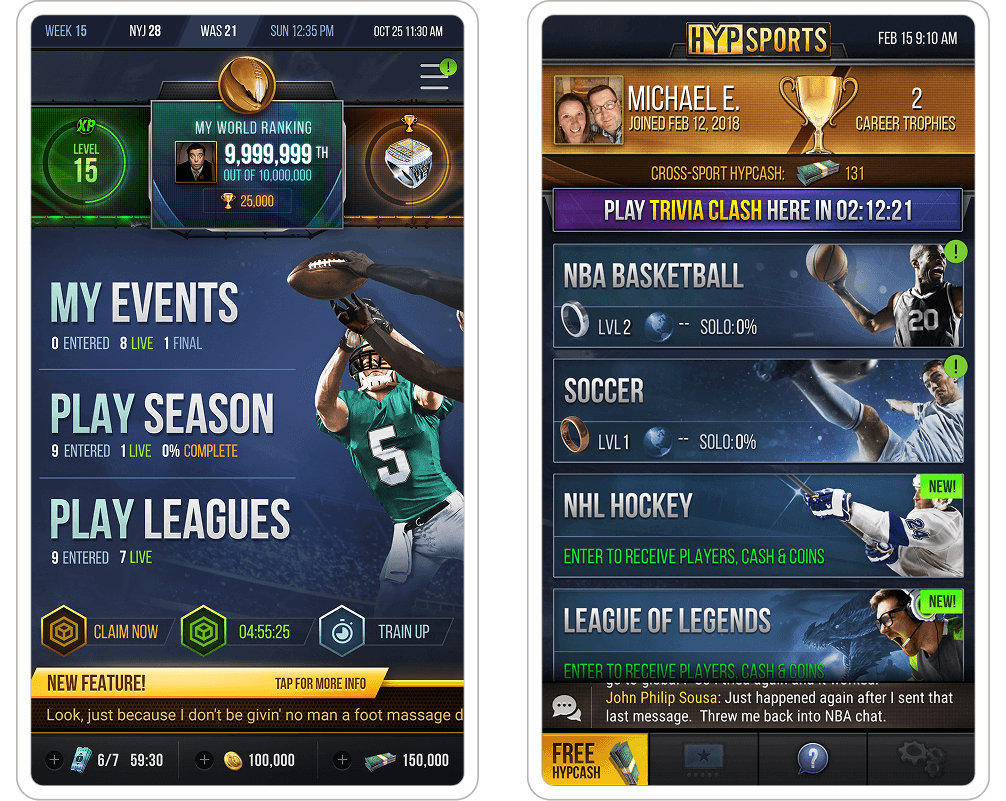
Fantasy sports UI carries a lot of information: rosters, matchups, live scoring, schedules, and an economy of currency and rewards. HypSports added mobile game mechanics on top of that, so the interface also had to communicate collecting, crafting, leveling, and pack opening in a way that felt rewarding rather than administrative.
The visual system had to do three things at once. Read as a game: card-based player collection, level progression, and rewards needed the tactile, satisfying quality of a mobile game, not the density of a fantasy portal. Respect the sports: six leagues plus esports lived in one lobby, and each needed its own identity while clearly belonging to a single product with a single wallet. And hold up on two platforms: the same look had to survive a Unity mobile build and a web build without becoming two different products.
The constraints
How it evolved
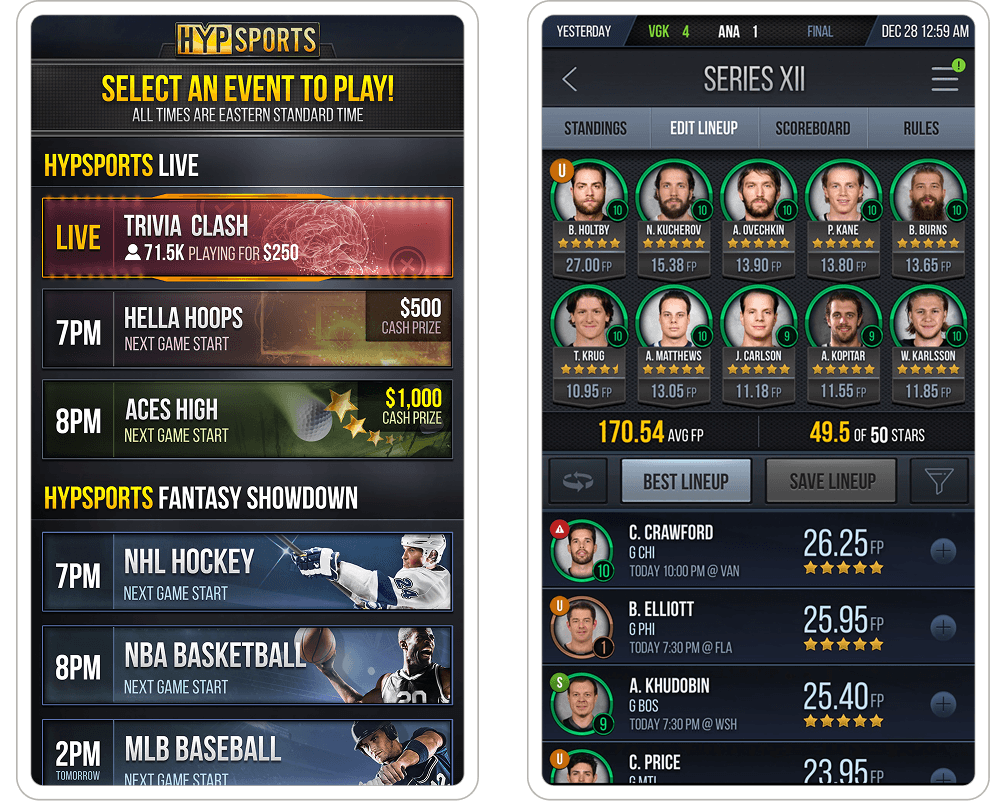
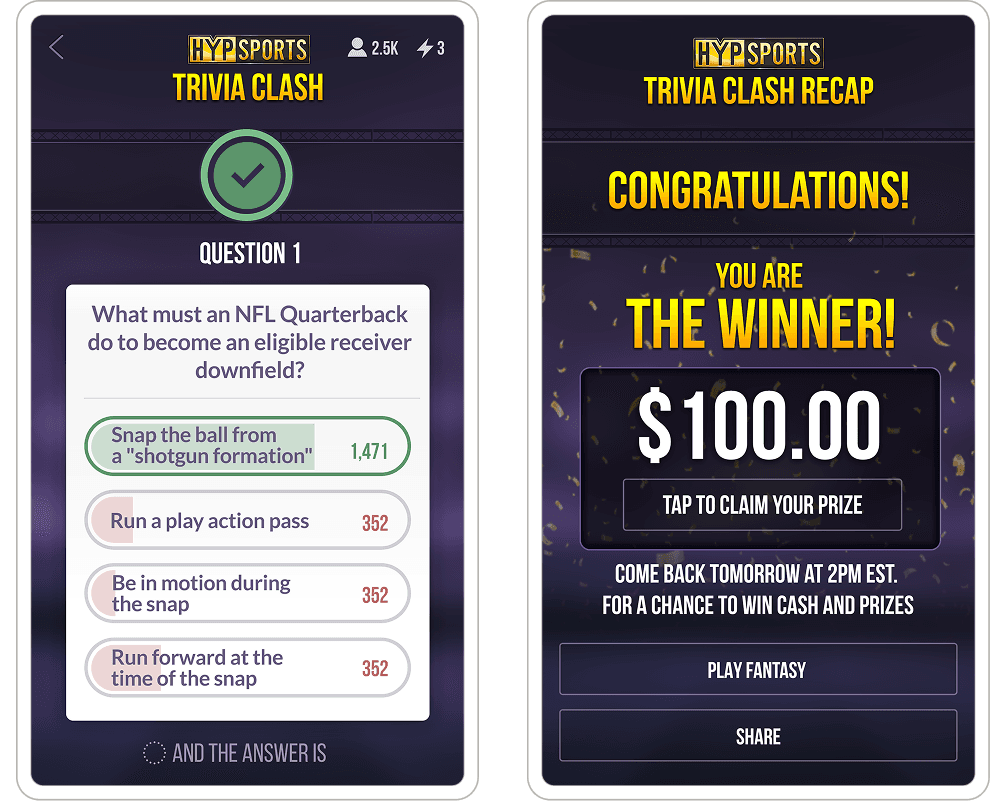
In 2018, with HQ Trivia proving that people would show up at a scheduled time to compete for cash, HypGames repositioned HypSports as a "playable media channel." Trivia Clash launched in April, followed by Basket Brawl (a 3D three-point shooting competition) in June and QB Shootout in August. Each ran on a broadcast-style daily schedule with live hosts and real cash prizes, while the season-long Showdown fantasy game stayed as the backbone, feeding rewards into the daily events.
For the visual and front end work, this meant the lobby had to become a TV guide as much as a game menu: a live calendar of scheduled events sitting next to season-long rosters, with one currency system connecting both.
What I did
Look development. I was responsible for how HypSports looked and felt: the visual language, UI styling, card and roster treatments, and the overall brand expression inside the app. Working alongside one other artist, I set the visual direction and produced the assets the product needed as it grew from a single fantasy mode into a full schedule of games.
Front end across two stacks. HypSports shipped on iOS, Android, and Facebook, which meant a Unity mobile client and a web client. I supported front end implementation on both, working directly with our front end developer to get designs into the build rather than handing off and hoping. Being in the code kept the visual work honest about what the engine and the web could actually render.
- Decision 1 of 4Set the visual direction: language, UI styling, card and roster treatments, and brand expression in-app
- Decision 2 of 4Produced assets alongside one other artist as the product grew into a full schedule of games
- Decision 3 of 4Supported front-end implementation on both the Unity mobile client and the web client
- Decision 4 of 4Adapted the lobby into a TV-guide hybrid when the 2018 pivot added daily live events
The outcome
At a glance
- 220k+
- Google Play Installs
- 4.36/5
- Avg Google Play Rating
We built and shipped HypSports as the company's first product across three platforms with a very small art and front end team. That shipped experience is what secured the funding that let HypGames grow into the studio it is today.
The company went on to ship Ultimate Golf with Miniclip, a consistent top-three golf title on mobile, and PGA TOUR Pro Golf on Apple Arcade, including a licensing partnership with TGL in 2026. I left in 2019 as that next chapter was beginning.
What it taught me
- 01Ship the look and the build together. Owning look development while working in the front end meant fewer surprises and a product that matched the design intent on both stacks.
- 02Small teams need a system, not a style. Two artists covering six leagues, an economy, and a live event schedule only works if the visual language is rule-based from the start.
- 03Games and sports data can coexist. The core insight of HypSports, that fantasy can be a game rather than a spreadsheet, is one I still design from.